In this article
What to know
- The guide concerns target engagement and progression, not generic memory claims.
- NADPARK and NR-SAFE were short early trials.
- Retail products and injected NAD do not inherit these results.
Brain exposure is an early question
NADPARK examined whether oral NR could change relevant biology in Parkinson's disease. That is a more specific question than whether an NAD supplement makes memory better, and a much earlier one than whether it slows disease progression. Thirty newly diagnosed, treatment-naive participants received oral NR at 1,000 mg per day or placebo for 30 days in the phase I experiment. [1] Its main value is evidence about target engagement and short-term feasibility. Treating it as a demonstrated disease-modifying therapy would skip the hardest part of the development program.
The practical distinction matters. A substance reaching or changing a biological target can justify a longer trial without establishing that continued use improves the person's future health.
Know what the study actually measured
The investigators used brain and other biological measurements to examine the response to NR. Cerebral NAD responses varied. [1] A variable response is scientifically interesting because it raises questions about exposure, measurement and biology. It does not create a ready-made consumer rule for selecting responders or changing a dose.
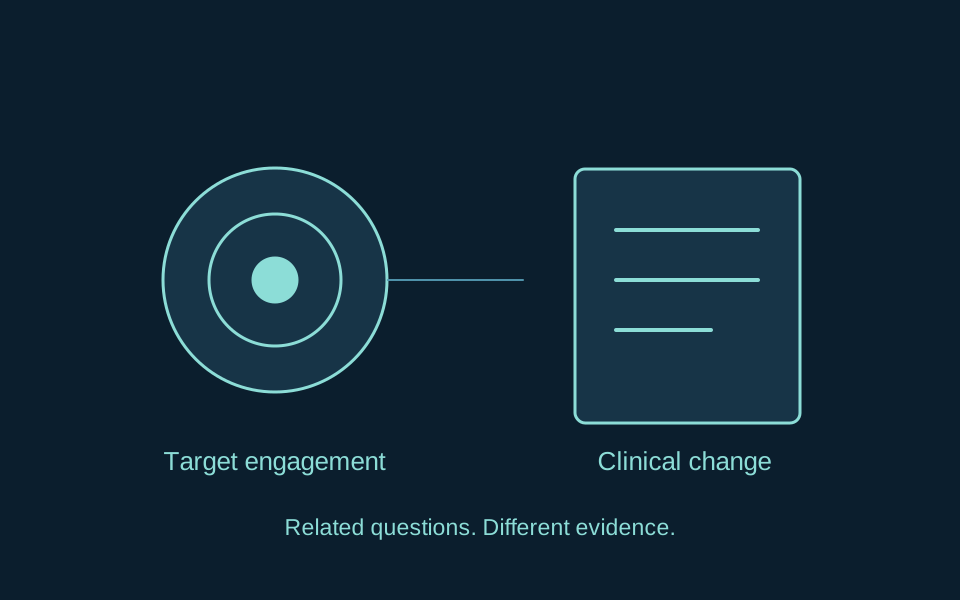
A useful reading separates the measurement from its interpretation. An observed brain-related signal is stronger evidence for engagement than an unrelated blood percentage, but it still does not measure long-term preservation of function. Ask whether the paper assesses chemistry, symptoms, disease trajectory or daily independence. Those are connected research questions with different requirements, not interchangeable names for the same success.
Phase I is a design feature
A small early study can answer whether it is reasonable to investigate an intervention further. It cannot reliably describe rare harm, years of exposure or the range of people seen in routine practice. Thirty days is especially short for a claim about altering the course of a chronic neurological condition.
This is not a reason to dismiss the work. It is a reason to identify the decision the work supports. A plausible next research step is different from an established prescribing conclusion. When a seller cites an early trial, the useful question is whether the claim preserves the study's stage and purpose. Removing phase I from the story removes information the buyer needs.
To understand the related evidence, read Nad brain health cognition.
What NR-SAFE adds
NR-SAFE randomized 20 people with Parkinson's disease to oral NR at 3,000 mg per day or placebo for four weeks (28 days), focusing on safety and tolerability. [2] It adds another controlled early experiment. It does not turn the longer-term efficacy question into a settled one. Short-term tolerability and exploratory symptom findings need to retain their original scope.
Small studies are vulnerable to imprecision, baseline differences and measurement conditions that can affect a clinical score. A symptom change also differs from evidence that underlying disease progression has slowed. A strong efficacy claim would require a design and duration capable of distinguishing those possibilities. A dose used under research supervision should not become self-treatment instructions.
Muscle evidence is not neurological replication
Elhassan's older-adult muscle study investigated NR-related metabolism in another tissue and population. [3] It provides a useful contrast: NAD research is not one single pool of interchangeable endpoints. Evidence in skeletal muscle cannot independently confirm a Parkinson's disease outcome, just as a blood test cannot substitute for a brain measure.
This matters when several papers appear together in a marketing reference list. A long list can contain valid experiments while only one directly addresses the claimed population and outcome. Count the relevant comparisons, not just the citations. A combination of mechanistic plausibility and several short studies can strengthen a research rationale without demonstrating a treatment benefit.
What disease modification would require
A convincing disease-progression claim would need an adequately designed controlled study with a suitable duration, clear clinical outcomes and attention to background treatment. It should specify how changes in symptoms and medication use are handled, rather than assuming every favorable score reflects preserved neurons. The clinical meaning of the difference should be understandable alongside statistical uncertainty.
Follow-up and missing data matter too. Participants who leave a trial should not disappear from the safety and feasibility story. A result based on a selected continuing group can answer a narrower question than the experience of everyone randomized. These are criteria for evaluating evidence, not a declaration that a future trial will necessarily succeed or fail.
For the practical product comparison, see Read the simple NR label review.
What a shopper should take away
NADPARK supports interest in NR as a research intervention in a defined Parkinson's population. NR-SAFE adds short-term safety information under another protocol. Neither establishes that a retail supplement, a blend or an NAD injection changes the course of Parkinson's disease. [1] [2] A commercial route change would add another unanswered question rather than inherit the phase I result automatically.
Someone living with Parkinson's disease should discuss research and supplements with the treating team, including existing medicines and trial participation where relevant. For a general shopper, the lesson is narrower: brain target engagement is useful evidence, but it is not the finished clinical claim. Do not let an interesting early signal become a promise the original investigators did not test.
Sources
Research describes groups and specific study conditions. Your medical history, symptoms and treatment decisions require advice from your own qualified clinician.