In this article
What to know
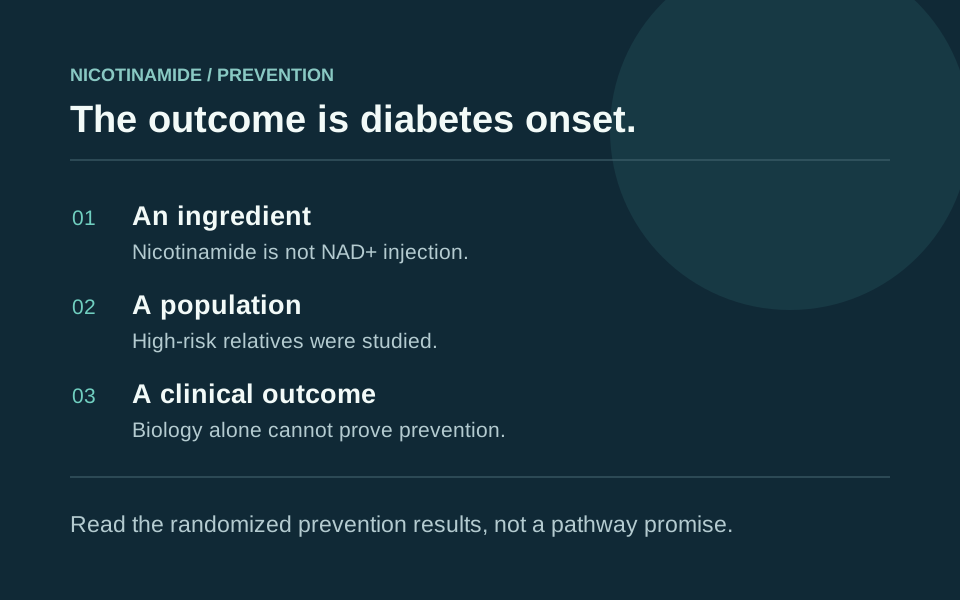
- ENDIT tested disease onset over five years, not just a blood marker. Nicotinamide did not prevent type 1 diabetes in the enrolled relatives.
- The study population, intervention and chosen outcome set the limits of the finding.
- A biological signal does not establish a broad wellness benefit.
A prevention claim received a direct clinical test
The most useful NAD-related studies are not always the ones with the most striking biomarker graphs. The European Nicotinamide Diabetes Intervention Trial, or ENDIT, asked whether oral nicotinamide could prevent or delay type 1 diabetes in relatives already identified as being at increased risk. It did not find that protection. [1] That is a clearer test of a clinical promise than an experiment showing that a supplement changes a blood measurement.
The result is worth reading on its own terms. It concerns nicotinamide, a particular formulation and regimen, and a selected population. It does not settle every question about NR, NMN or injected NAD. It does, however, show why a plausible relationship between NAD biology and cell protection cannot establish disease prevention without an appropriate trial.
Who entered ENDIT, and what was measured
ENDIT randomized 552 relatives with confirmed islet-cell antibodies and a nondiabetic oral glucose-tolerance test. Participants received modified-release nicotinamide or placebo for five years. The primary outcome was development of diabetes, analyzed by original randomized assignment. [1] The trial was therefore about progression to clinical disease in an at-risk group, not treatment after diagnosis or general metabolic wellness.
That distinction prevents a common misunderstanding. A family history alone does not describe the complete enrollment criteria, and feeling tired or having an unfavorable consumer NAD test does not recreate this study population. The intervention was also a research regimen rather than an ordinary dietary recommendation. Reading the eligibility and endpoint together makes the result more informative while limiting the temptation to use its details as instructions for self-treatment.
Read our human trial-dose guide for the next part of the decision.
What the main result actually says
Of the 159 participants who developed diabetes, 82 had been assigned nicotinamide and 77 placebo. The unadjusted hazard ratio was 1.07, with a 95% confidence interval from 0.78 to 1.45. [1] The investigators concluded that nicotinamide was ineffective at the dose used. The point estimate did not favor protection, and the uncertainty interval does not justify a confident preventive claim.
A neutral result is not a proof that every imaginable benefit is impossible. The interval describes uncertainty around the tested comparison; it is not permission to advertise the most favorable edge as the expected benefit. The practical conclusion should follow the whole result. A consumer pitch that retains only the biological rationale while leaving out the clinical outcome has reversed the order of evidence that matters for a disease-prevention decision.
An earlier high-risk childhood trial was also unconvincing
The German DENIS study randomized 55 children aged three to twelve who were siblings of people with type 1 diabetes and had high-titer islet-cell antibodies. Rates of diabetes onset were similar with nicotinamide and placebo. [2] Its sequential design was intended to detect a very large protective effect, and the authors acknowledged that smaller effects were not excluded.
This is an important limitation, but it should not be mistaken for positive evidence. Failing to exclude a smaller effect is different from demonstrating one. DENIS is most helpful as an earlier direct test whose uncertainty made a larger trial relevant. ENDIT subsequently provided a substantially larger clinical comparison. The two studies should be read as a sequence of questions and results, rather than as competing opportunities to select whichever conclusion sounds most encouraging.
Standard nicotinamide did not solve the prevention question
A separate randomized, double-blind trial enrolled 40 first-degree relatives with persistent islet-cell antibodies and compared standard nicotinamide with placebo over five years. Diabetes development was similar between groups, and the investigators did not find prevention or delay at the tested dose. [3] This smaller study matters because it examined another preparation rather than simply repeating the modified-release label.
Together, the trials leave no persuasive basis for treating a bottle of nicotinamide as a demonstrated prevention strategy for an at-risk relative. They also show why swapping a formulation after an unfavorable trial is a new hypothesis, not an automatic solution. A different preparation needs its own results. In this instance, the additional study did not provide the clinical rescue that a mechanism-led argument might have suggested.
Keep type 1 prevention separate from insulin-sensitivity research
These studies examined progression to type 1 diabetes in selected relatives. [1] [2] [3] That is a different question from whether a precursor affects insulin sensitivity in a metabolic trial, or whether a supplement changes a fasting laboratory value. The word diabetes can make those topics appear closer than their actual study questions are.
A useful way to read a commercial claim is to write down the disease context, the molecule and the measured outcome before considering the conclusion. If any of those changes, the supporting argument needs to be checked again. A favorable finding in one metabolic setting cannot override a direct unfavorable prevention result in another. Likewise, this prevention evidence should not be casually used to dismiss every unrelated investigation of NAD metabolism. Specificity protects both the reader and the research.
Read our insulin-sensitivity evidence review for the next part of the decision.
Safety reporting does not turn an ineffective intervention into value
ENDIT reported no difference in serious adverse-event counts between treatment groups, while 168 participants withdrew during the trial. [1] Those are useful pieces of context for interpreting the experiment. They do not establish that all high-dose nicotinamide use is harmless or that unsupervised long-term supplementation is a worthwhile response to family risk.
Effectiveness and tolerability answer separate questions. If an intervention does not demonstrate the hoped-for prevention, a reassuring average safety comparison cannot supply the missing benefit. Ask about the intended purpose before comparing brands or paying for a long course. For a person concerned about inherited or antibody-related risk, the relevant next conversation is with an appropriate clinician about assessment and available care, rather than choosing a supplement by a laboratory pathway alone.
The consumer conclusion is more specific than the mechanism
The intervention in these trials was nicotinamide, also called niacinamide. Keep that exact molecule visible in any summary. The trials did not test every product that uses NAD in its branding. [1] [2] [3] They tested a clinically meaningful preventive claim and did not establish it in the enrolled relatives.
That leaves a useful purchasing boundary. Do not buy a nicotinamide product on the expectation that these trials demonstrate prevention of type 1 diabetes. Do not reinterpret a higher NAD-related measurement as evidence that the disease outcome must improve. The strongest feature of this research is that it moved beyond a surrogate marker and counted disease onset. Its negative result deserves to remain as visible as the promising biology that made the studies worth doing.
Read our biomarker versus benefit guide for the next part of the decision.
Sources
Research describes groups and specific study conditions. Your medical history, symptoms and treatment decisions require advice from your own qualified clinician.