In this article
What to know
- A randomized NR-and-walking trial missed its main blood-pressure comparison. Nighttime subgroup findings need separate confirmation.
- The study population, intervention and chosen outcome set the limits of the finding.
- A biological signal does not establish a broad wellness benefit.
The headline belongs to the planned comparison
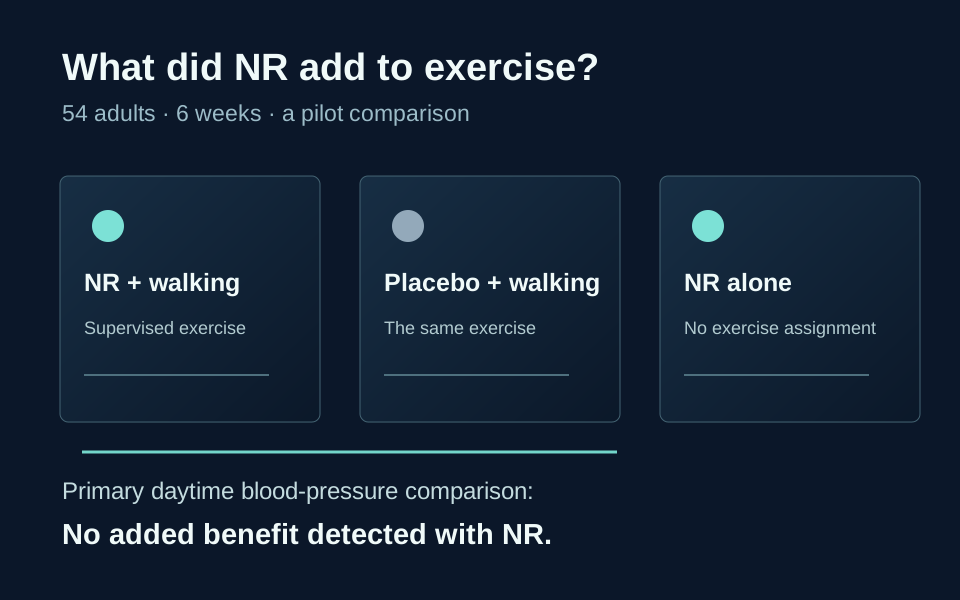
Can an NAD precursor make exercise more effective for blood pressure? That is a narrower and more useful question than asking whether NAD is good for cardiovascular health. In a 2025 pilot, adding nicotinamide riboside to supervised walking did not beat placebo plus the same walking program on the primary daytime systolic blood-pressure outcome. The investigators reported exploratory nighttime findings, but those do not replace the unsuccessful main comparison. [1]
For a reader considering an NR supplement, this distinction changes the purchase decision. The paper supplies a test of an appealing combination, with an answer that remains cautious. It does not establish a supplement-based hypertension treatment or a reason to alter prescribed medication. A trial can advance understanding by showing which plausible prediction did not work under its actual conditions. That is useful evidence even when it makes a less exciting headline.
What the participants actually received
The trial randomized 54 sedentary adults aged at least 55 years to six weeks of NR plus exercise, placebo plus exercise, or NR alone. The NR regimen was 1,000 mg daily; supervised walking lasted 30 minutes three days each week. Forty-nine participants completed all visits. These details define the experiment, rather than a general instruction for supplement users. [1]
The cleanest question is what adding NR contributed when the walking assignment was held the same. An NR-alone arm broadens the exploratory picture, but the absence of a placebo-alone arm limits what can be inferred about NR by itself. It would also be inappropriate to translate a supervised six-week program into a prediction about occasional exercise, a different precursor, or a clinic injection. Changing those ingredients creates another question that this comparison did not answer.
Read our NR trial-dose guide for the next part of the decision.
A blood-pressure measurement is a particular endpoint
Daytime ambulatory systolic pressure was the primary outcome. The study also examined nighttime pressure, arterial stiffness and NAD-related urine metabolites. Those measurements are related questions rather than interchangeable versions of one result. [1] A biochemical response can indicate that exposure changed without establishing a clinical improvement.
Keep the measurement method beside any quoted number. Daytime readings, nighttime readings and a clinic measurement describe different sampling conditions. A consumer summary that selects whichever moved most favorably can conceal the original study question. Nor does a short-term pressure experiment tell us how many heart attacks or strokes a supplement prevents. A longer outcome claim needs evidence built to examine those events, rather than a chain of assumptions connecting several attractive laboratory findings.
Why the nighttime observation remains exploratory
The investigators identified a post hoc nighttime blood-pressure signal among participants who were not taking antihypertensive medication. They described the finding as a reason for further investigation. [1] Post hoc means the analysis was undertaken after the main study plan, which matters when deciding how much confidence to place in a favorable subset.
Subgroup selection reduces the number of people behind an estimate. Examining several outcomes also creates more opportunities to encounter an apparently encouraging pattern. These are reasons to seek a prospective repeat, not reasons to insist the observation is meaningless. A convincing next study would name the medication subgroup and nighttime outcome before data collection, recruit enough participants for that question, and report the result even if it disappointed. Until then, the observation is a hypothesis to investigate rather than a rule for choosing patients.
Read our NMN arterial-stiffness analysis for the next part of the decision.
Earlier NR findings provide context rather than rescue
The 2018 Martens crossover trial studied six-week NR and placebo periods in middle-aged and older adults, with 24 completing the trial. Its vascular findings were exploratory and the authors called for further research. [2] A separate eight-week NIAGEN dose-ranging study found no between-group difference in mean systolic or diastolic pressure. [3]
These trials cannot be averaged informally into a confident blood-pressure promise. They used different populations and study priorities. The relevant reading habit is to ask whether a later study confirmed the earlier suggestion in an appropriate population. Repeating an old favorable subgroup quotation beside a newer neutral primary outcome does not make the newer result positive. Equally, a small neutral study cannot prove that every possible NR regimen has no effect. The defensible conclusion should stay close to the tested question.
How this changes a supplement comparison
If two bottles differ in dose, price or added polyphenols, the hypertension pilot does not tell us which is the better purchase. Matching the trial dose would reproduce only one feature of the experiment. It would not recreate participant selection, supervision, baseline medication use or measurement. Spending more to reach a study regimen is therefore not an evidence-based shortcut to the study outcome.
Blood NAD measurements do not solve that uncertainty either. The question here concerns pressure control, so an increased precursor-related marker is not the deciding score. For a reader already discussing a supplement with a clinician, the useful conversation is about the intended purpose, current medicines, financial commitment and how any benefit would be evaluated. A clear bottle label helps identify the product. It cannot establish the outcome that the clinical comparison failed to demonstrate.
Read our biomarker interpretation guide for the next part of the decision.
The proportionate conclusion
The strongest take-home message is specific: NR plus supervised walking was not superior to placebo plus walking on the planned daytime blood-pressure comparison in this pilot. [1] That conclusion should travel with any mention of the nighttime subgroup. Neither a promising mechanism nor an exploratory subset justifies presenting the combination as a proven hypertension strategy.
A good consumer decision can acknowledge interesting research without turning participation details into self-treatment instructions. Keep established care discussions with the treating clinician, and assess any optional supplement on its full cost and uncertain additional benefit. Future work may refine who, if anyone, benefits from this approach. The present paper earns attention for testing that possibility directly, while leaving a much narrower claim than a general promise of vascular rejuvenation.
Sources
Research describes groups and specific study conditions. Your medical history, symptoms and treatment decisions require advice from your own qualified clinician.