In this article
What to know
- The randomized study included thirty clinically stable HFrEF patients.
- Whole-blood NAD and immune-cell measurements are not hospitalization or survival outcomes.
- Research amounts do not provide personal dosing instructions.
The result is an early clinical step
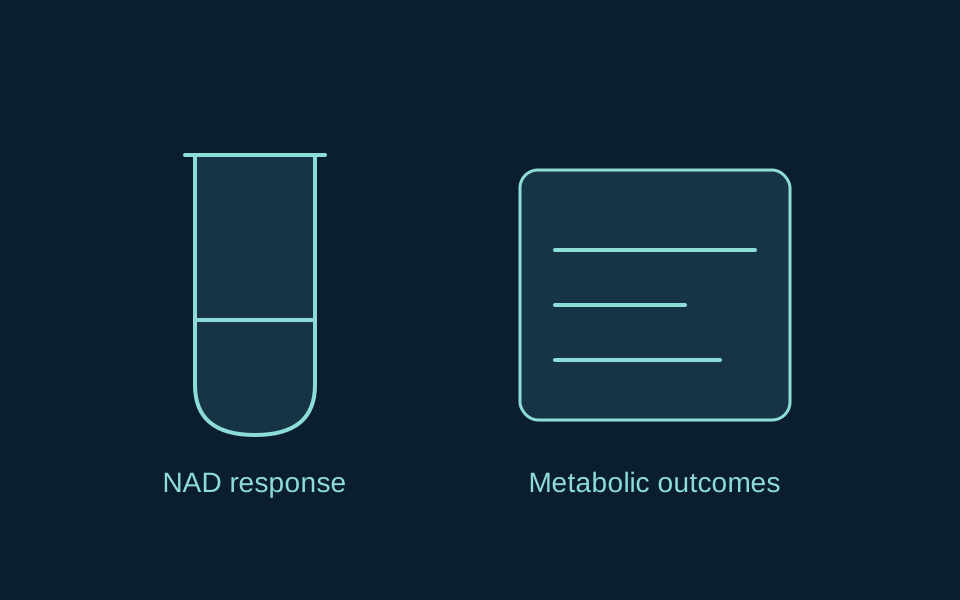
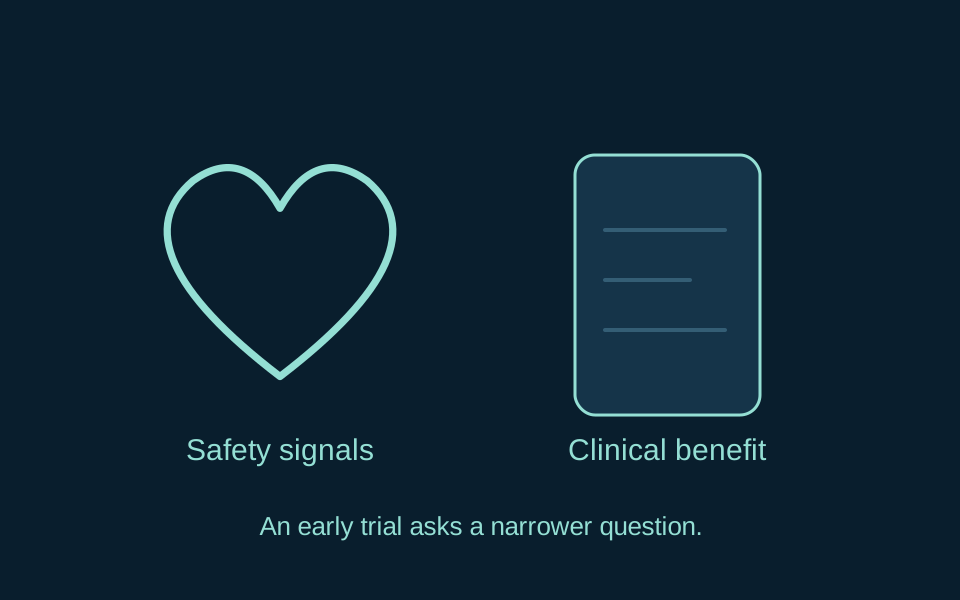
Nicotinamide riboside has been tested in people with heart failure, but the key randomized study was a safety and tolerability experiment. It was not a demonstration that a supplement prevents admission or extends survival. Wang and colleagues randomized thirty people with stable heart failure and reduced ejection fraction to NR or placebo for twelve weeks. Whole-blood NAD approximately doubled with NR. [1] That is an interesting human result in a clinically relevant population. It is also a much narrower statement than saying that boosting NAD treats heart failure.
The first question is what the investigators designed the trial to establish. That keeps a real advance in early research from becoming a treatment recommendation it cannot support.
Thirty participants cannot answer every safety question
The study allocated twenty participants to NR and ten to placebo. Following titration, the active group received 1,000 mg twice daily during the final nine weeks. The investigators did not find significant between-group differences in adverse events, serious adverse events or treatment-emergent laboratory abnormalities. [1] These amounts describe the research protocol; they are not a consumer dosing recommendation.
A small trial can show whether a regimen is feasible enough to investigate further. It has much less ability to detect uncommon problems or effects appearing after years of use. No significant difference should therefore be read with the sample size and observation period attached. Removing those boundaries turns a useful safety signal into an assurance the experiment was too small to provide.
The blood response is not a cardiac outcome
The biological measurements supported engagement with the NAD pathway. Increases in NAD correlated with changes in respiration and inflammatory expression in peripheral blood mononuclear cells. [1] Those are blood immune-cell measurements, not a direct measurement of improved pumping function or fewer heart-failure events. Correlation among changes also does not establish that one change caused another.
The useful interpretation is a mechanistic lead worth testing. A subsequent efficacy trial would need outcomes appropriate to the claim, with adequate power and follow-up. A shopper should not substitute a larger NAD percentage for those outcomes. It is possible to be persuaded that a compound reaches an interesting biological target while remaining unconvinced that buying it improves the condition that motivated interest.
For the wider evidence context, read nad biomarkers and benefits.
Stable reduced-ejection-fraction disease is a specific setting
The trial recruited clinically stable patients with reduced ejection fraction and applied exclusions for several other illnesses or recent events. [1] Its findings cannot simply be extended to someone recently hospitalized, someone with preserved ejection fraction or a person who has never been assessed for heart failure. The trial protocol identifies safety as the main question and documents the planned clinical setting. [2]
This is why the population belongs beside the headline. The words heart health can cover everything from a supplement bought by a healthy runner to complex disease managed with multiple medicines. A study of one group cannot provide the missing clinical judgment for all of them. The experiment is more informative when its boundaries remain explicit.
Earlier healthy-volunteer work answers a different question
Martens and colleagues studied NR in a randomized crossover experiment in healthy middle-aged and older adults. It supported tolerability and increases in NAD metabolism over short study periods, with exploratory cardiovascular observations. [3] That is helpful background for why researchers pursued additional trials. It does not independently confirm a heart-failure treatment benefit.
The distinction matters when a product page assembles several favorable studies into one broad cardiovascular narrative. More papers do not necessarily mean repeated tests of the same clinical question. Put the population, preparation, duration and endpoint in separate columns. If the columns differ, the papers may be complementary steps in a research program rather than replications of an outcome a consumer can expect.
What a useful next trial would need to add
An efficacy claim should name an outcome that matters to people with the condition: symptoms, physical capacity, hospitalization or survival, depending on the proposed purpose. The trial should specify that outcome before results are known and compare groups receiving appropriate background care. A blood marker can remain useful as supporting information, but it should not displace the clinical question because its percentage looks more impressive.
Duration and event numbers also matter. A short experiment can be appropriate for initial tolerability without being suitable for a long-term prognosis claim. These are ordinary standards for interpreting a treatment study. They explain why the current result is worth following while being insufficient as a reason to replace established care or add a high-dose regimen without the treating team's knowledge.
The consumer decision is narrower than the mechanism
For someone with heart failure, this research is a reason to discuss an emerging strategy with the treating team, not a reason to convert a supplement label into a disease-management plan. The team needs the exact product, complete ingredient list and current medicines to assess an individual question. A retail capsule may differ from the study preparation and a blend introduces additional ingredients.
For a generally healthy NAD shopper, the lesson is to value the clinical boundary. The study supports short-term investigation in a defined stable population and a measurable blood response. It does not establish broader protection from heart disease. Product comparisons can still examine composition, cost and purchase obligations, but none of those commercial details supply the missing outcome trial. The most credible conclusion leaves room for promising research without selling certainty.
For a practical assessment of the offering, see our Tru Niagen review; its purchase terms do not establish the clinical outcome.
Sources
Research describes groups and specific study conditions. Your medical history, symptoms and treatment decisions require advice from your own qualified clinician.