In this article

What to know
- NR-SAFE tested 3,000 mg daily in 20 people for four weeks. Its short-term tolerability result does not overcome the later, larger NOPARK trial’s unfavorable clinical findings.
- Interpret the actual formulation, population and measured endpoint together.
- A commercial program needs a separate clinical and financial assessment.
A safety experiment answers a narrower question
NR-SAFE found that 3,000 mg of oral nicotinamide riboside daily was tolerated over four weeks in a small group of people with Parkinson's disease. That supports a bounded statement about the observed experiment. It does not establish a long-term safe consumer dose or prove that NR changes the disease course. The distinction is especially important after the larger NOPARK trial reported unfavorable clinical results in October 2026. [1] [3]
A high-dose safety headline can sound like permission to escalate an ordinary supplement. The actual question was whether a monitored clinical experiment could examine this exposure. Feasibility for further research and a good reason for a person to take that amount are different conclusions. The second requires more than the absence of a short-term safety signal.
Read the earlier trial in context in NADPARK and subsequent Parkinson evidence.
Twenty participants and a four-week window
NR-SAFE was a single-center, randomized, double-blind phase I study. Ten participants received NR at 1,500 mg twice daily and ten received placebo. All twenty completed the study. Its primary outcome concerned moderate and severe treatment-associated adverse events. [1] The hospital's study description similarly identifies safety and tolerability over four weeks as the objective. [2]
The small exposure group matters. Ten treated people can reveal an obvious tolerability problem, but they cannot characterize uncommon harms with precision. Four weeks also cannot answer what happens after repeated months or years. The duration and sample are therefore limits on the conclusion, even if the investigators observed the participants carefully and every enrolled person completed the planned visits.
A strong blood response is target engagement
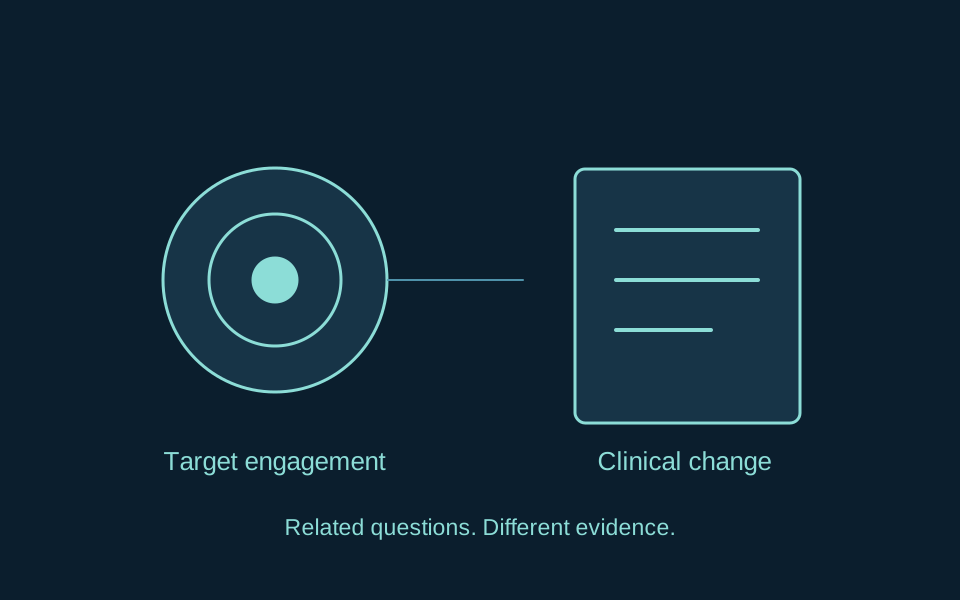
The trial found a substantial increase in blood NAD-related metabolites with NR. [1] That is relevant to whether the intervention affected the biochemical pathway it was intended to affect. It does not establish that a person moved better, remained independent longer or experienced slower neurological progression.
This is a useful distinction for evaluating any NAD product. A blood measurement can help establish exposure or biological activity while remaining an incomplete guide to clinical value. Comparing two preparations by the size of a biomarker increase alone skips the question of whether the change is helpful in the condition being treated. A larger biochemical response is not a substitute for a patient-centered outcome or a sufficiently long controlled comparison.
For the target-engagement distinction, see NAD biomarkers and benefit.
The symptom signal had an important qualification
The small study reported an improvement in total MDS-UPDRS symptom scores, but the authors also noted a shorter interval since participants' most recent levodopa dose. [1] That qualification matters because the trial was not designed to establish durable disease modification. A measurement taken under different medication-timing conditions can be difficult to attribute solely to the experimental supplement.
My reading is that the symptom observation was a reason to investigate, rather than a basis for declaring efficacy. Randomization is valuable, but it does not make every secondary measurement definitive. The clinical question becomes more demanding when a result is intended to guide long-term treatment rather than decide whether another trial is justified.
The later NOPARK result changes the clinical picture
NOPARK randomized 410 participants with early Parkinson's disease to NR 1,000 mg daily or placebo for 52 weeks. Among 393 participants in the primary analysis, the MDS-UPDRS parts I–III score increased by 2.45 points with NR and decreased by 0.27 with placebo. The adjusted difference was 2.72 points, with a 95% confidence interval of 0.47 to 4.98, favoring placebo. [3]
These were different doses, durations and trial objectives. NOPARK therefore is not a direct long-term test of NR-SAFE's 3,000 mg regimen. It is, however, much more relevant to a claim that NR improves Parkinson's clinical outcomes. The unfavorable result should not be omitted when presenting the earlier safety study to a consumer deciding whether the ingredient has established disease-modifying value.
Statistical and clinical interpretations both matter
The NOPARK abstract states that the observed clinical outcomes were worse with NR and that the findings do not support NR as a disease-modifying treatment for Parkinson's disease. [3] A consumer explanation should preserve that conclusion without converting an average score difference into a prediction for every individual.
The distinction also prevents selective reassurance. A tolerability result from a small, short study cannot cancel an unfavorable efficacy result from a larger, longer study. Equally, the longer trial does not establish that every possible NR use has the same result. Good interpretation remains tied to the question actually tested. The relevant response is to narrow claims, rather than treat one study as a verdict on the entire NAD field.
A study regimen is not a shopping instruction
The hospital frames NR-SAFE as a clinical safety investigation and marks the study completed and published. [2] It is not a consumer dosing guide. A research protocol includes selection, monitoring and interpretation around a clinical question; a supplement label or self-selected stack does not automatically reproduce that arrangement.
For a person with Parkinson's disease, the appropriate discussion concerns the existing treatment plan, symptoms, concurrent products and the current evidence. This article supplies no instruction to increase, stop or substitute a medicine. The practical point for reading a product advertisement is simpler: a study's high exposure should not be presented as a reason to buy more capsules without establishing why that exposure is appropriate to the person's actual goal.
Compare the wider dose literature in supplement dosage evidence.
How I would judge a product claim citing NR-SAFE
A faithful claim identifies the oral ingredient, the four-week window, the twenty-person sample and the safety objective. It also acknowledges the later clinical evidence when discussing Parkinson's benefits. Anything broader needs its own support. A supplier cannot transfer this experiment to an infusion, injection or multi-ingredient blend just by placing NAD+ in the product description.
Our conclusion is that NR-SAFE contributed useful early tolerability information for monitored research. NOPARK makes it particularly inappropriate to turn that early finding into a disease-modifying promise. A commercial review can still compare labels, costs and purchase terms, but those practical judgments must stay separate from a neurological treatment claim that the larger trial did not support.
Sources
Research describes groups and specific study conditions. Your medical history, symptoms and treatment decisions require advice from your own qualified clinician.